


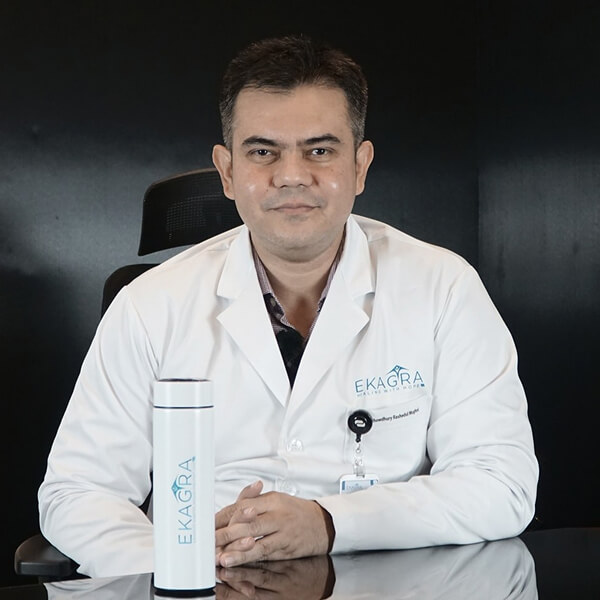
Breast augmentation is surgery that increases breast size or restores volume using a silicone or saline implant. In Dhanmondi, Dhaka, Dr. Mughni plans each operation around the patient’s own frame: implant type, size, placement, and incision. This page explains who is suitable, how the surgery is done, recovery, published risks, and the 2026 cost range in Bangladesh.
Reviewed by Dr. Chowdhury Rashedul Mughni, BMDC reg. A 41174. This page is for general educational purposes and is not a substitute for in-person clinical assessment by a qualified plastic surgeon. Treatment decisions depend on individual factors that can only be evaluated during a consultation with Dr. Mughni. As Dr. Mughni puts it: “The first step is to accept that, without scar no surgery is possible.”
To find out whether breast augmentation is right for you, you can arrange a consultation with Dr. Mughni at EKAGRA Health, Dhanmondi, or Cosmetic Surgery Centre, Satmasjid Road. Phone and WhatsApp: 01842-182545.
What is breast augmentation?
Breast augmentation is surgery that places an implant behind the breast tissue to increase size, improve shape, or correct uneven breasts. The ISAPS Global Survey for 2024 ranked it third among surgical procedures, with just over half of patients aged 18 to 34.
Augmentation is one of the main operations within Dr. Mughni’s breast surgery practice, alongside reduction and lift. It changes volume but does not, on its own, lift a breast that has dropped significantly. Where sagging is the main concern, a breast lift (mastopexy) or a lift combined with an implant is usually the better plan.
In Bangladesh, silicone augmentation has been performed and reported for over two decades. Bangladeshi series published in the Bangladesh Journal of Plastic Surgery describe silicone gel augmentation for underdeveloped breasts, with complications described as minimal over limited follow-up. Longer-term risk figures on this page come from larger international studies.
Who is a candidate for breast augmentation?
A good candidate is a healthy adult with fully developed breasts, a stable body weight, and a clear, realistic idea of the result she wants.
Common reasons women in Bangladesh consider augmentation include:
• Breasts that never developed to the size expected (hypoplasia)
• Volume lost after pregnancy, breastfeeding, or weight loss
• A noticeable size difference between the two breasts
Women who also have loose abdominal skin after pregnancy can read about abdominoplasty with Dr. Mughni; it is planned as a separate procedure.
Surgery is usually postponed for women who are pregnant or breastfeeding, who have an active infection, or who have breast cancer or a pre-cancerous condition that has not been fully treated. These are listed contraindications in US FDA-approved implant labelling. In the United States, the FDA approves silicone implants for cosmetic augmentation from age 22 and saline implants from age 18. Smokers are advised to stop well before surgery, because smoking slows wound healing.
Which implant is right for me?
The right implant depends on your chest width, the thickness of your breast tissue, and the result you want.
Silicone vs saline
Silicone gel implants are the most widely used type in the UK and across Asia, and they feel closer to natural breast tissue.
| Feature | Silicone gel implant | Saline implant |
|---|---|---|
| Filling | Silicone gel | Sterile salt water |
| Feel | Closer to natural breast tissue | Firmer; more likely to show rippling |
| If the shell breaks | Usually “silent”; imaging is needed to detect it | Deflates visibly; the body absorbs the saline |
| Monitoring | FDA advises MRI or ultrasound at 5 to 6 years, then every 2 to 3 years | Not covered by the silicone screening schedule |
| Minimum age (US FDA) | 22 for cosmetic augmentation | 18 |
Round vs teardrop, smooth vs textured
Round implants are symmetrical, so their shape does not change if they turn. Teardrop (anatomical) implants slope like a natural breast, and their labelling stresses careful pocket creation to prevent rotation. Surface is a trade-off: meta-analyses link smooth implants to more capsular contracture, while textured implants are more strongly associated with the rare lymphoma BIA-ALCL. The full comparison is on the page covering silicone, saline, round, and teardrop implants.
Choosing a size
The right size is set by your body, not by a cup letter. Sizing is based on chest width, the width of the breast base, and how much tissue will cover the implant. For a woman with a slim frame and thin tissue, Dr. Mughni’s preference is a moderate implant that fits the width of the chest, in keeping with her natural body structure. An implant that is too wide or too heavy for the tissue can show edges, ripple, or stretch the skin over time.
How is breast augmentation performed?
Breast augmentation is usually done under general anaesthesia and takes about 60 to 90 minutes. Some patients go home the same day; others stay one night, which affects the cost.
Where the implant sits
The implant can sit over the chest muscle, under it, or both.
| Placement | What it means | Points to consider |
|---|---|---|
| Subglandular (over the muscle) | Implant sits between breast tissue and the chest muscle | The muscle is not lifted; edges may show more in thin tissue |
| Submuscular / subpectoral | Implant sits partly or fully under the chest muscle | More tissue cover; a 2025 meta-analysis found lower odds of capsular contracture |
| Dual plane | Upper implant under the muscle, lower part under breast tissue | Keeps upper cover while improving how the implant sits in the lower breast |
With thin tissue over the upper chest, more muscle cover is often considered.
Where the incision goes
There are three common incisions.
| Incision | Where the scar sits | Points to consider |
|---|---|---|
| Inframammary | In the fold under the breast | Direct access; a 2018 meta-analysis found lower capsular contracture rates than the areola incision |
| Periareolar | Along the lower edge of the areola | Scar can blend with the colour change; higher contracture rates in the same meta-analysis |
| Transaxillary | In the armpit | No scar on the breast; favoured in Asian surgical reviews where a visible breast scar is a concern |
Skin type is part of this decision. Darker skin is more prone to thickened (hypertrophic) or keloid scars, familial keloid clusters have been reported among Indian families, and the front of the chest is one of the higher-risk areas. Dr. Mughni chooses the incision and plans scar care with this in mind.
What is recovery like after breast augmentation?
Most patients are up the same day, back at desk work in one to two weeks, and doing most normal activities by six weeks.
A typical recovery, based on NHS guidance:
• First few days: soreness and tightness across the chest, managed with prescribed pain relief. A supportive or sports bra is worn as your surgeon advises.
• Week 1: no driving for at least one week.
• Weeks 1 to 2: stitches removed if they are not dissolvable. Most patients with desk jobs return to work.
• Weeks 4 to 6: heavy lifting and strenuous exercise remain off-limits for at least a month.
• Around 6 weeks: most normal activities resume. Scars begin to fade.
• After a few months: the breasts look and feel more natural, and the support bra can usually stop.
Scars keep softening for many months, and scar care continues through follow-up. The week-by-week breast surgery recovery guide covers each stage in more detail.
What results can I expect from breast augmentation?
The aim is fuller breasts in proportion with your frame, which look and feel more natural after a few months, once swelling settles. It is not permanent in every detail.
In the first weeks, the breasts usually feel tight and firm and can look fuller at the top than they will later. That is swelling, not the final shape.
Breasts continue to age, and pregnancy and weight change still affect them. Keeping a stable weight after surgery protects the result.
What are the risks of breast augmentation, and how are they managed?
The main risks are capsular contracture, rupture, further surgery, and, rarely, BIA-ALCL. The US FDA states that implants are not lifetime devices and that complications become more likely the longer they are in place.
Figures below come from published studies, not from any single practice:
• Capsular contracture. The scar tissue around the implant tightens and the breast becomes firm or misshapen. Long-term implant studies summarised in American Family Physician (2021) reported 10-year rates of about 18.9% for silicone cosmetic augmentation. Meta-analyses link higher rates to smooth implants (Liu et al., 2015), placement over the muscle (Haas et al., 2025), and the areola incision (Li et al., 2018).
• Rupture. Silicone ruptures are usually silent, so the FDA advises MRI or ultrasound at 5 to 6 years after surgery and every 2 to 3 years after that.
• Further surgery. Implants may need replacing at some point. The NHS notes some women need another operation around 10 years later, because of implant problems or natural breast changes.
• BIA-ALCL. A rare lymphoma of the immune system, not breast cancer, that develops in the fluid or capsule around an implant. It is estimated at about 1 in 30,000 implant patients (possibly higher), is more strongly associated with textured implants, and usually appears 8 to 11 years after surgery as new swelling.
• Other risks. Bleeding, infection, changes in nipple sensation, asymmetry, implant malposition, and rippling. Some women report symptoms such as fatigue and joint pain, sometimes called breast implant illness. These are poorly understood.
Risk is managed by choosing an implant, plane, and incision to suit the tissue, explaining warning signs before surgery, and reviewing any new swelling, pain, or change in shape promptly at follow-up.
For women planning a family, a 2014 meta-analysis found that women with cosmetic implants were less likely to breastfeed exclusively. Many still breastfeed successfully. The evidence is explained on the page about breastfeeding after breast surgery.
How much does breast augmentation cost in Bangladesh?
At Dr. Mughni’s practice in 2026, the breast augmentation procedure fee typically ranges from BDT 120,000 to 190,000, with implants charged separately. The final figure is set only after a consultation and examination.
The range includes the surgeon’s fee, operating theatre charge, anaesthesia, and follow-up visits. It does not include the implants, medications, support garments, or bed rent. Pre-operative investigations are billed separately by the diagnostic centre where they are done. Payment is made in stages: at booking, on the day of surgery, and after the operation.
The figure varies with:
• How complex the case is and which technique is chosen
• Primary augmentation or revision surgery
• The length of hospital stay
If a revision is needed within the first 6 to 12 months, it is offered at a reduced fee. The consultation fee is BDT 1,200 at EKAGRA Health and BDT 1,500 at Cosmetic Surgery Centre. Patients travelling from abroad will find planning details on the page for NRB and international patients. The full breakdown is in the 2026 breast surgery cost guide.
Dr. Mughni’s approach to breast augmentation
Dr. Mughni’s approach is honest about scars and aims for a result that suits the patient’s own body.
Dr. Chowdhury Rashedul Mughni notes:
“The first step is to accept that, without scar no surgery is possible. Post-surgery weight management is very important.”
Asked what he explains most often to breast surgery patients, Dr. Mughni names two things: the scar, and weight. In consultation, the scar comes first: where it will sit, how it will change as it matures, and why there is no augmentation without one. Then weight: a significant gain or loss after surgery changes the breast around the implant, and with it the result. He prefers a result that respects the patient’s natural body structure over a size the tissue cannot support.
He treats the pre-operative discussion as a must, not a formality. Patients leave knowing their options, the published risks, and the long-term follow-up their implant needs.
Why patients choose Dr. Mughni for breast augmentation
Dr. Mughni brings over two decades of surgical experience, including more than twelve years specialising in plastic surgery. He holds FCPS (Bangladesh College of Physicians and Surgeons), MRCS, and MRCSEd (Royal College of Surgeons of Edinburgh) qualifications. He is Office Secretary of the Bangladesh Society of Aesthetic and Plastic Surgeons (BSAPS) and a member of the International Society of Aesthetic Plastic Surgery (ISAPS).
His work spans aesthetic, reconstructive, and diabetic foot surgery, and he approaches breast surgery as restoring form and proportion. You can read his full training and career history on the About Dr. Mughni page and patient accounts on the patient testimonials page.
Where is breast augmentation performed?
Consultations are available at both of Dr. Mughni’s chambers in Dhanmondi. Surgery is carried out at the chamber or at an admitting hospital, depending on the plan agreed at consultation.
• EKAGRA Health, Dhanmondi: Wahab Point, Floor 7, House 13, Road 2, Dhanmondi, Dhaka 1209. Saturday, Monday, and Thursday, 4 PM to 8 PM; Sunday, Tuesday, and Wednesday, 9 AM to 2 PM.
• Cosmetic Surgery Centre, Satmasjid Road: 5th floor, Shankar Plaza, 72 Satmasjid Road, Dhanmondi R/A, Dhaka 1209. Consultation times can be confirmed by phone.
Phone and WhatsApp for both chambers: 01842-182545. Either chamber can arrange a consultation to discuss whether augmentation suits you.
Frequently asked questions
How long do breast implants last?
Breast implants are not lifetime devices. There is no fixed expiry date, but the chance of needing further surgery rises over time. The NHS notes that some women need another operation around 10 years after augmentation, either for an implant problem or natural breast changes.
Is silicone or saline better?
Neither is better for everyone. Silicone feels closer to natural tissue and is the more common choice. Saline is firmer and ripples more, but a rupture is easy to see and the saline is absorbed safely. Silicone needs periodic MRI or ultrasound to check for silent rupture. The choice depends on your tissue and preference.
Will breast augmentation leave a scar?
Yes. Every augmentation leaves a scar, placed in the breast fold, around the areola, or in the armpit. Scars begin to fade from about six weeks and continue to soften for many months. Darker skin is more prone to thickened scars, so incision position and scar care are planned for each patient at consultation.
Can I breastfeed after breast implants?
Many women breastfeed after augmentation. A 2014 meta-analysis found women with cosmetic implants were less likely to breastfeed exclusively, possibly because of surgery near the milk ducts or pre-existing underdevelopment of the breast. If you plan to have children, tell Dr. Mughni so placement and incision can be discussed with this in mind.
How soon can I go back to work?
Most patients with desk jobs return to work after one to two weeks. Jobs involving lifting or physical strain need longer. Driving is avoided for at least one week, and heavy lifting and strenuous exercise for at least a month. Dr. Mughni gives a personal timeline at follow-up based on how healing is progressing.
Does breast augmentation cost the same at both chambers?
The procedure range of BDT 120,000 to 190,000 applies at both chambers, with only minor differences. Implants, medications, garments, and bed rent are charged separately. The first consultation fee is BDT 1,200 at EKAGRA Health and BDT 1,500 at Cosmetic Surgery Centre. The final cost is confirmed after examination.
Making the decision
Breast augmentation is a decision worth taking slowly, with honest information about the scar, the implant, and the years after surgery. More answers are in the breast surgery FAQ by Dr. Mughni. When you are ready to talk it through, Dr. Mughni offers consultations at both Dhanmondi chambers.
This page is reviewed for medical accuracy. See the medical disclaimer for more information.