


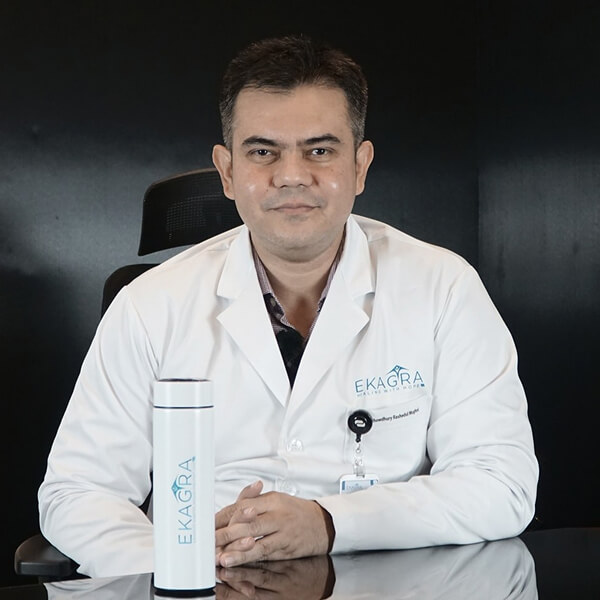
Rhinoplasty, often called a nose job, is surgery that reshapes the nose to improve its appearance, its breathing, or both. This page answers 30 common questions from patients considering rhinoplasty with Dr. Mughni at EKAGRA Health, Dhanmondi, Dhaka. It covers consultation, the operation, pain, recovery in Dhaka conditions, swelling in thicker skin, risks, revision, cost in Bangladesh, and travel.
Reviewed by Dr. Chowdhury Rashedul Mughni, BMDC reg. A 41174. This page is for general educational purposes and is not a substitute for in-person clinical assessment by a qualified plastic surgeon. Treatment decisions depend on individual factors that can only be evaluated during a consultation with Dr. Mughni.
If you would like to discuss whether rhinoplasty suits your nose and your goals, you can arrange a consultation with Dr. Mughni at EKAGRA Health, Dhanmondi. Call or WhatsApp 01842-182545 for information.
What should you know before a rhinoplasty consultation?
Before a consultation, check that you are a suitable candidate and old enough, and know what the visit will cover.
Who is a good candidate for rhinoplasty?
A good candidate is in good general health, has finished nasal growth, does not smoke or is willing to stop, and has a clear, realistic goal. Rhinoplasty can address a hump, a wide or drooping tip, asymmetry after injury, or a blocked airway. Dr. Mughni confirms suitability only after examining the nose in person.
What is the minimum age for rhinoplasty?
Surgery should wait until the nose has stopped growing. The American Society of Plastic Surgeons puts this at around 15 to 16 for girls and 16 to 18 for boys. Teenagers also need parental consent and emotional maturity. The page on age requirements for nose surgery covers this in detail.
What happens at the first consultation?
Dr. Mughni examines the outside and inside of your nose, checks your breathing, asks about your health and goals, and explains what your anatomy can and cannot support. A rhinoplasty series from Combined Military Hospital, Dhaka, linked patient satisfaction to good pre-operative counselling and realistic expectations. The consultation fee at EKAGRA Health is BDT 1,200.
Will my nose still suit my face and heritage?
Yes, that is the aim. Dr. Mughni prefers to preserve cultural features and natural body structure rather than reshape every nose to a single standard. The goal is a nose that fits your face and works well. His approach is explained further on preserving South Asian features in rhinoplasty.
How is rhinoplasty performed?
Rhinoplasty reshapes bone, cartilage, or both, through either an open or a closed approach, under general anaesthesia or local anaesthesia with sedation.
| Closed rhinoplasty | Open rhinoplasty | |
|---|---|---|
| Where the cuts are made | Inside the nostrils only | Inside the nostrils plus a small cut across the columella |
| Visible scar | None | A small scar across the columella, usually fading to a fine line |
What is the difference between open and closed rhinoplasty, and will there be a scar?
Closed rhinoplasty is done through cuts inside the nostrils, so no scar is visible. Open rhinoplasty adds a small cut across the columella, the strip of skin between the nostrils, which usually heals into a fine line. The choice depends on what needs changing. See the comparison of open and closed techniques.
Will I be awake during the operation?
Not necessarily. Rhinoplasty can be done under general anaesthesia, where you are fully asleep, or under local anaesthesia with sedation, where the nose is numbed and you are drowsy. The right choice depends on how much work is planned and on your health. Dr. Mughni discusses this with you at consultation.
How long does the surgery take, and will I stay in hospital?
It depends on the operation. A tip refinement is a smaller operation than a full primary rhinoplasty, and revision surgery is often more involved. Whether you go home the same day or stay overnight also varies with the technique and anaesthesia used. Dr. Mughni gives you the expected time and stay after examining you.
What happens in the first week after rhinoplasty?
The first week brings mild discomfort, a splint on the nose, and bruising around the eyes that settles within two to three weeks.
Does rhinoplasty hurt?
Expect the nose to feel blocked and sore at first, mainly from swelling and the splint. According to the American Society of Plastic Surgeons, pain medicine is usually needed for only one or two days. Keeping your head raised, resting, and taking prescribed medicine on time help keep the first days comfortable.
Will my nose be packed after surgery?
Usually not. Dr. Mughni does not routinely pack the nose after every rhinoplasty. Packing is used only when there is a specific reason linked to the technique or your needs. This matches published evidence: a meta-analysis found routine packing after septal surgery gave no benefit and may raise infection risk.
When does the splint come off?
An external splint usually stays on for about one week, and any internal splints for one to seven days. While it is on, the nose feels stiff and blocked, and you may need to breathe partly through your mouth. Dr. Mughni reviews you at around five days and removes it then or soon after.
How long does bruising last?
Bruising and swelling around the eyes are usually most visible in the first few days. They mostly settle within one week and are generally gone within two to three weeks. Do not put ice directly on the nose. Sleeping with your head raised above your chest helps the swelling go down.
How long does rhinoplasty recovery take?
Most people return to desk work within a week, but glasses, exercise, and Dhaka conditions need longer care.
| Time after surgery | What to expect |
|---|---|
| Days 1 to 2 | Pain medicine usually needed; head kept raised |
| Days 3 to 5 | Desk work often possible; first review at about 5 days |
| About 1 week | External splint removed; most eye bruising settled |
| 2 to 3 weeks | Remaining bruising gone; mild exercise resumes |
| 4 to 6 weeks | Glasses can rest on the nose again (as advised) |
| 6 weeks | About half of swelling gone; strenuous exercise and contact sport can resume |
| 12 to 18 months | Final shape judged in thicker nasal skin |
When can I go back to work or study?
For a straightforward primary rhinoplasty, Dr. Mughni usually clears patients for desk work after about three to five days, depending on swelling, bruising, and how they feel. Physical jobs need a longer break. The week-by-week recovery timeline sets out each milestone in detail.
Can I wear glasses after rhinoplasty?
Avoid resting glasses or sunglasses on the bridge of your nose for about four to six weeks. Pressure from the frame can affect the healing bones. Use cheek rests, tape the frame to your forehead, or switch to contact lenses. Dr. Mughni may advise a longer period depending on the surgery.
When can I exercise again?
Mild exercise usually resumes after two to three weeks, once Dr. Mughni has checked your healing. Strenuous exercise, heavy lifting, and contact sports should wait at least six weeks, because a knock can disturb the healing nose. Avoid blowing your nose, and sneeze with your mouth open during the early weeks.
Does Dhaka’s dust, heat, and traffic affect recovery?
Yes, and Dr. Mughni adjusts his advice for it. Avoid dusty areas in early recovery and wear a mask when needed. Limit long exposure to heat and direct sun. Long rickshaw or CNG journeys can be uncomfortable because of dust, pollution, heat, and road vibration, so keep such travel to a minimum for the first few weeks.
When will you see your final rhinoplasty result?
Most swelling settles within weeks, but final refinement takes about a year, and longer when the nasal skin is thicker.
How long does swelling last after rhinoplasty?
Visible swelling falls quickly at first. About half has usually gone by six weeks, but mild swelling continues for months, often worse in the morning. The tip stays swollen longest. Thicker nasal skin needs more healing time, and a study measuring skin thickness linked thicker skin to more swelling in the first week.
When will I see the final shape of my nose?
Nasal skin thickness varies between people and between ethnic groups. For patients with thicker nasal skin, Dr. Mughni advises waiting around 12 to 18 months before judging the final result. This slow change is expected healing, not a complication. The American Society of Plastic Surgeons notes the final result can take one to two years.
Are rhinoplasty results permanent?
The structural changes are long-lasting, because removed bone or cartilage does not grow back. Your nose will still change gradually with age, as the rest of your face does, and an injury can alter it. Protect the nose from knocks while it is healing.
Can I see before-and-after photos?
Yes. Photos are shown only with patient consent, and faces are blurred to protect privacy. Use them to understand the range of change that suits different noses, not as a promise of your own result. Your result depends on your skin, cartilage, bone structure, and healing, which Dr. Mughni assesses individually.
What are the risks, and what if you need a revision?
Every operation carries risk. Stopping smoking and following aftercare reduce it, and revision is considered only after healing.
What are the main risks of rhinoplasty?
Recognised risks include bleeding, infection, reaction to anaesthesia, breathing difficulty, numbness, an uneven result, lasting swelling or discolouration, scarring, a hole in the septum, and a change in sense of smell. Some patients need further surgery. Each is explained in the full guide to rhinoplasty risks and complications.
How should I prepare for rhinoplasty, and must I stop smoking?
Stop smoking and vaping well before surgery, because they slow healing, raise infection risk, and can cause tissue to die. You will also need pre-operative tests, such as a blood count, ECG, and anaesthesia clearance. Arrange someone to take you home, and plan quiet time for the first week.
What if I am not happy with the result?
Give the nose time first. Shape keeps changing for months, and a second operation is generally not done until at least a year after surgery. If the need is identified during the first six to twelve months of follow-up, Dr. Mughni offers the revision at a discounted rate. See what revision rhinoplasty involves.
How often is revision surgery needed?
Published figures vary with technique and patient group. A 2017 systematic review reported reoperation rates of roughly 1.5% to 2.7% for primary rhinoplasty across the studies it included. These are figures from published surgical series, not from any individual surgeon’s practice, and they do not predict your own risk.
What should you know about rhinoplasty fees and payment?
With Dr. Mughni, rhinoplasty typically ranges from BDT 45,000 to 120,000, and the final figure is set only after an in-person consultation.
What is the typical price range for rhinoplasty with Dr. Mughni?
Dr. Mughni’s typical range is BDT 45,000 to 120,000. The figure depends on complexity, technique, primary or revision surgery, anaesthesia type, and length of stay. No two noses need exactly the same work, so the final amount is set only after Dr. Mughni has examined you. See the 2026 rhinoplasty pricing guide.
What is included in the price?
The quoted range covers the surgeon’s fee, operation theatre charges, and anaesthesia. Medicines and hospital bed rent are charged separately, and pre-operative tests are billed by the diagnostic centre where they are done. The consultation fee is also separate. Your final estimate after assessment explains which costs apply to your case.
Does health insurance cover rhinoplasty?
Dr. Mughni’s chambers do not currently accept health insurance for rhinoplasty, and there is no instalment financing partner. If you hold a private or employer policy that might cover breathing-related surgery, check with your insurer before your operation, since cosmetic rhinoplasty is not usually covered.
How do I pay?
Cash in taka, credit card, and bank transfer in taka are accepted. Payment is made in stages rather than all at once: a portion at booking, a portion on the day of surgery, and the rest after the operation. The exact stages are explained when your final estimate is given at consultation.
What about breathing, travel from abroad, and non-surgical options?
Rhinoplasty can improve breathing as well as shape. Overseas patients need to plan around follow-up, and filler suits only small changes.
Can rhinoplasty fix breathing problems?
Often, yes. When a blocked airway is caused by a bent septum, weak side walls, or an injury, surgery can improve airflow as well as shape. Septal correction (septoplasty) can be done in the same operation. Dr. Mughni checks the inside of the nose at consultation and explains this further in rhinoplasty for breathing problems.
I live abroad. How long should I stay in Bangladesh?
Plan your stay around the early follow-up visits. Dr. Mughni usually sees patients at about five days and two weeks after surgery, with later checks at one, three, six, and twelve months. Discuss your flight dates with him before booking, so the early visits and splint removal happen before you leave.
Is there a non-surgical alternative?
For small concerns, hyaluronic acid filler can smooth a minor bump or lift a low tip without surgery. It cannot remove tissue, narrow the nose, or improve breathing, and it wears off. Rarely, filler blocks a blood vessel, which can be serious. Compare both options on the page about non-surgical nose reshaping.
When should you consult Dr. Mughni in person?
Consult in person once you have a clear concern about your nose’s shape or breathing and want to know what surgery can realistically achieve.
Your skin, cartilage, bone structure, and breathing decide what is possible, and only an examination shows that. Dr. Chowdhury Rashedul Mughni puts it this way:
“I prefer preserving cultural features and natural body-structure, for rhinoplasty and also for other body reshaping surgeries. Always a pre-operative discussion with the patient is a must to task for me.”
In practice, the consultation starts with your own face: your skin, your bridge, your tip, and your breathing. The plan is built from what your anatomy can support, and the honest conversation about limits happens before surgery, not after it.
For technique, candidacy, and recovery in depth, start with Dr. Mughni’s complete rhinoplasty guide. When you are ready, you can request a consultation time at EKAGRA Health, Dhanmondi.
Where can you find more rhinoplasty resources?
Photos and background on Dr. Mughni are on the pages below.
• The rhinoplasty before-and-after gallery, with consented, face-blurred photos.
• Dr. Mughni’s training and surgical background, including his FCPS, MRCS, and MRCSEd.
• Practical planning for overseas patients on the guide for NRB and international patients.
A good rhinoplasty result is one that looks like it belongs on your face and lets you breathe well: form and function together. Understand the healing, ask every question, and decide at your own pace.