


At Dr. Mughni’s practice in Dhanmondi, Dhaka, an eyebrow transplant moves single hair follicles from the back of the scalp into thin, scarred or missing brows. Each hair is placed at the same angle as your natural brow hairs, so the result follows your own brow shape. It suits brow loss from scars, burns, injury, plucking or ageing. Most of the result is visible by about 8 months.
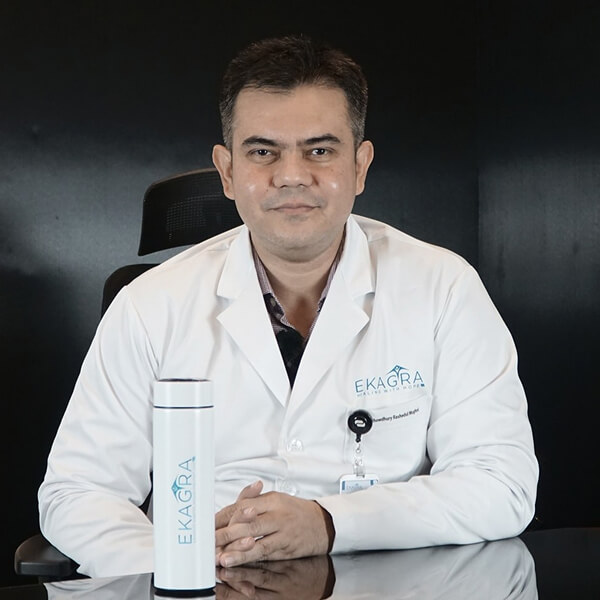
Reviewed by Dr. Chowdhury Rashedul Mughni, BMDC reg. A 41174. Plastic, Aesthetic, Reconstructive, Diabetic Foot & Hair Transplant Surgeon, with more than twelve years specialising in plastic surgery. Read about Dr. Mughni’s training and credentials
This page is for general educational purposes and is not a substitute for in-person clinical assessment by a qualified plastic surgeon. Treatment decisions depend on individual factors that can only be evaluated during a consultation with Dr. Mughni.
If your brows are thin or patchy and you want to know whether a transplant suits you, arrange a consultation with Dr. Mughni.
What is an eyebrow transplant?
An eyebrow transplant is a minor surgical procedure that takes hair follicles, usually from the back of the scalp, and places them into the brow.
Surgeons also call it eyebrow restoration. Each follicle is moved as a single unit and set into the brow skin one by one. The hair that grows is your own scalp hair, so it keeps the growth pattern of scalp hair: it grows longer than natural brow hair and needs regular trimming.
Who is an eyebrow transplant for?
It is for people whose brow hair is thin, patchy or missing because of scars, burns, injury, long-term plucking, laser removal or ageing.
In a 2018 systematic review of 354 patients, burns were the most common cause. A brow interrupted by a scar from an accident, a burn or earlier surgery can often be filled with transplanted hair, a technique known as scar camouflage.
A transplant is not always the right first step:
• Thyroid problems. An underactive thyroid can cause brow hair fall. This should be checked and treated first.
• Alopecia areata. This type of hair fall can return. Published series report recurrence or poor growth in transplanted hairs when the condition is still active.
• Ongoing plucking habit. If plucking or pulling continues, it should be addressed before surgery.
How does an eyebrow transplant work?
Single-hair grafts are taken by FUE, then each hair is placed almost flat to the skin, following the direction of natural brow growth.
FUE removes individual follicles from the back of the scalp with a fine punch, leaving tiny marks that surrounding hair covers. The strip method (FUT) is rarely needed for brows; see the difference between FUE and FUT.
Natural brow hairs do not all point the same way, so the hair growth angle changes zone by zone:
• Inner brow (head): hairs point upward.
• Upper border: hairs angle outward and slightly downward.
• Middle (body): hairs run along the length of the brow.
• Lower border: hairs cross the upper rows, creating the natural crisscross pattern.
Finer single hairs go to the upper edge and the tail. Grafts are spaced 1 to 1.5 mm apart, and wider in scarred skin. Hairs placed at the wrong angle can stick outward or curl, which published reviews describe as one of the most common problems after eyebrow transplant. Other reported risks are uneven density, asymmetry and, rarely, infection, folliculitis or small cysts.
How is the brow shape designed?
The shape is planned around your face, your remaining brow hairs and your natural bone structure.
A published Indian review describes around 70 to 90 grafts for a female brow, placed in 2 to 3 rows, and around 150 to 200 for a thick male brow. Numbers depend on remaining brow hair.
Dr. Mughni’s preference for preserving natural features carries into brow design: the aim is a brow that looks like your own, not a fashion shape. Women may also want to read about female hair transplant options, and men about beard transplant surgery.
When do eyebrow transplant results show?
Swelling and bruising settle within a few days, the transplanted hairs shed from about two weeks, and new growth appears from about 3 months.
| Time after surgery | What usually happens |
|---|---|
| Days 1 to 5 | A crust forms at each graft, like a line of dots along the brow. Do not pick them. Swelling settles. |
| Around day 10 | Crusts come away, with some hairs. |
| From about week 2 | Most transplanted hairs shed. The follicles stay in place. |
| Months 3 to 4 | About half of the grafts begin to grow. |
| Months 5 to 8 | Most remaining grafts grow. |
| Months 8 to 14 | Density continues to mature. |
Dr. Chowdhury Rashedul Mughni notes:
“Patients have to accept the fact that it will take time to see visible result. There will be hair fall which is absolutely normal after hair transplantation.”
For general aftercare, see the day-by-day recovery guide.
Do transplanted eyebrows need trimming or a second session?
Transplanted brow hairs grow like scalp hair, so they need trimming every 2 to 3 weeks to keep the brow shape.
A little petroleum jelly or coconut oil helps train the hairs to lie flat. In one published series of 63 cases, most patients had two sittings. A second session is planned only after the first has fully grown, no earlier than 9 to 10 months later.
How much does an eyebrow transplant cost in Dhaka?
Hair transplant at Dr. Mughni’s practice is priced at BDT 25–65 per graft, and the final cost is set only after an in-person assessment.
The total depends on graft numbers and technique. The range includes the surgeon fee, operating theatre charge and anaesthesia. Pre-operative investigations and medications are billed separately. Consultation fees are BDT 1,200 at EKAGRA Health, Dhanmondi, and BDT 1,500 at Cosmetic Surgery Centre, Satmasjid Road. Our hair transplant cost guide for Dhaka covers the factors.
Dr. Mughni’s perspective
Brow loss after a burn or an injury is a reconstructive problem as much as a cosmetic one. As a plastic and reconstructive surgeon, Dr. Mughni treats the brow as part of the face’s form, not a separate feature. He regards an honest pre-operative discussion as essential: the shape is drawn, checked in the mirror and agreed before any graft is taken. The goal is a brow that restores the face’s balance, so the patient stops noticing it.
Frequently asked questions
Is an eyebrow transplant permanent?
Transplanted hairs keep growing once they establish, because they are your own scalp hair. The main exception is when the original cause is still active. Published series report recurrence or poor growth in patients with active alopecia areata, so that condition is assessed before surgery.
Is an eyebrow transplant painful?
The procedure is done under local anaesthetic, so the brow and donor area are numb during surgery. You stay awake in most cases. Afterwards, mild tenderness, swelling and bruising are common and settle on their own within a few days. Simple pain relief is enough.
Will my transplanted eyebrows fall out?
Yes, most transplanted hairs shed from about two weeks after surgery. The follicle stays in the skin and begins a new growth cycle. In one published series, about half of grafts start growing at 3 to 4 months, and the result is largely visible by about 8 months.
Can an eyebrow transplant cover a scar?
Often, yes. Scars from burns, injury or surgery are among the most common reasons for eyebrow transplant. Scar tissue has a poorer blood supply, so published studies report lower graft survival than in normal skin. Grafts are spaced more widely in scars, and a second session may be needed.
A natural brow takes time
Placed at the right angle and in a shape that suits your face, transplanted hairs grow into a brow that looks like your own. For the wider picture, read the complete guide to hair transplant in Bangladesh.