


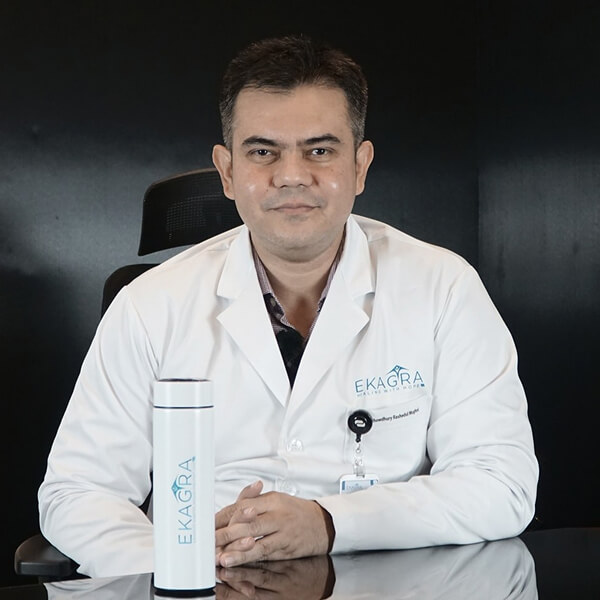
A beard transplant moves hair follicles, usually from the back of the scalp, into thin or empty areas of the beard, moustache or sideburns. In Dhaka, Dr. Mughni usually performs it with FUE under local anaesthetic. New hairs shed first, regrowth starts at around 3–4 months, and the final result is judged at about 10–14 months. Fees in Bangladesh are quoted per graft and confirmed at consultation.
Reviewed by Dr. Chowdhury Rashedul Mughni, BMDC reg. A 41174. This page is for general educational purposes and is not a substitute for in-person clinical assessment by a qualified plastic surgeon. Treatment decisions depend on individual factors that can only be evaluated during a consultation with Dr. Mughni.
What is a beard transplant?
A beard transplant is a hair restoration procedure that places individual hair follicles into the face to create or thicken a beard, moustache or sideburns. Based in Dhanmondi, Dhaka, Dr. Chowdhury Rashedul Mughni performs beard transplants as part of his wider hair transplant practice, using the same principles of design and natural density that guide scalp work.
The procedure relocates hair you already have. The angle of each graft decides whether the result looks like a beard or like a transplant.
Who is a good candidate for a beard transplant?
Good candidates have a stable cause of beard loss and enough donor hair at the back of the scalp.
Patients usually fall into three groups:
| Group | Typical aim | Donor demand | Sessions |
|---|---|---|---|
| Patchy beard | Fill gaps on cheeks, chin or jaw | Lower | One; a second if needed |
| Sparse or absent beard (genetic) | Build a full beard | Higher | One or two |
| Scar or traction hair loss | Restore hair in damaged skin | Varies with scar size | Often more than one |
Burns, acne scars, accidents and cleft lip surgery can leave areas where hair no longer grows. Tight knotting of beard hair can also cause traction hair loss along the jaw, a pattern documented in published South Asian cases.
Scarring is a common reason for beard reconstruction. In one Indian series of 20 men treated with FUE beard reconstruction, 75% had hair loss from burn scars, 15% from acne scars and 10% from a congenitally absent beard.
Alopecia areata is different. It is an autoimmune condition that causes round, smooth patches of hair loss and can recur. A 2023 review reported recurrence rates of 15–25.5%. A published FUE beard series excluded patients with alopecia areata, and treatment is usually medical first.
Why does a full beard matter to patients in Bangladesh?
For many men in Bangladesh, a full beard carries personal, cultural or religious meaning. A thin or patchy beard can feel like more than a cosmetic concern.
The International Society of Hair Restoration Surgery has reported that the largest increases in facial hair procedures between 2010 and 2012 were in the Middle East and Asia. The usual aim is a beard that looks like the patient’s own, at a density that suits the face, not a dramatic change.
Where do the grafts come from?
The back of the scalp is the main donor area, because its hair is coarse and resembles beard hair. Hair from under the jawline can be used as a secondary donor.
| Donor area | Why it is used | Limitation |
|---|---|---|
| Back and sides of the scalp | Coarse, thick hair that closely matches beard hair; usually the largest supply | Draws on the same supply that may be needed later for scalp hair fall |
| Under the jawline (beard hair) | Good match in texture | Yields fewer follicles, so it suits smaller areas |
The donor supply is finite. Every graft moved to the face cannot later go to the scalp, which matters for a young man with a family history of hair fall.
How is a beard transplant performed?
Most beard transplants use FUE (follicular unit extraction) under local anaesthetic. A linear strip harvest is an alternative but leaves a line scar at the donor site; the trade-offs are set out in how FUE and FUT differ.
Design comes first
The design is drawn at the consultation and finalised on the day of surgery. Each zone is mapped separately: moustache, chin, cheeks, jawline and sideburns. The cheek line is placed to match the face, not drawn as a sharp, artificial edge. Men treating the upper lip alone can read the dedicated guide to moustache restoration, and the same design thinking applies to eyebrow transplant surgery.
| Zone | Typical goal | Design point |
|---|---|---|
| Moustache | Fill or define the upper lip | Fine, single hairs near the lip line |
| Chin and goatee | Central density | Joins smoothly into the moustache |
| Cheeks | Close gaps, set the cheek line | A soft, natural upper border |
| Jawline and neck | Frame the face | Matches the direction of growth under the jaw |
| Sideburns | Connect scalp hair to beard | Blends the hairline into the cheek |
Preparation, harvesting and placement
Any active skin problem in the beard area is treated before surgery, and topical minoxidil on the face is stopped beforehand. On the day, any existing beard is trimmed to about 3–5 mm so grafts can be placed between existing hairs. Follicles are extracted one at a time. Beard hair grows mostly as single hairs, so multi-hair units are often divided into single-hair grafts. Each graft is placed with fine forceps or an implanter, at the angle of natural growth.
What is recovery like after a beard transplant?
Most patients have mild discomfort and bruising for a few days. In one published series, bruising settled within 4–5 days.
In the first few days, the grafts should not be rubbed or pressed. Strong, direct sunlight should be avoided while the skin heals. Patients are usually able to shave the area at about two weeks. If you wash your face several times a day for prayer, ask Dr. Mughni at the consultation how to do this gently in the first days after surgery. In Dhaka’s heat and dust, keep the face clean and shaded while it heals.
When will I see results?
The transplanted hairs fall out first, then regrow from about 3–4 months. The final result is judged at around 10–14 months.
| Time after surgery | What usually happens |
|---|---|
| 1–2 weeks | Transplanted hairs shed; the follicles stay in place |
| About 3–4 months | New hairs begin to grow |
| 6–9 months | Density builds gradually |
| 10–14 months | Final result can be judged |
Month two is often the hardest stretch. The transplanted hairs have shed, and in the mirror the face can look much as it did before surgery. This is expected, not a failure. A second session to add density may be planned after about a year, once the first result has matured.
What are the risks?
A beard transplant carries real risks, and darker skin needs particular care. The International Society of Hair Restoration Surgery reports:
• Darkening of the skin (post-inflammatory hyperpigmentation) at the transplant sites, mainly in darker skin, which may need treatment.
• Lightening of the skin at the donor area, also more noticeable in darker skin.
• Wrong angle or direction of grafts, causing unnatural growth that may need correction.
• Folliculitis (inflamed hair follicles) and small bumps, most often under the lip and on the chin.
• Using up donor hair that may be needed for future scalp hair fall.
Many Bengali patients have medium to darker skin tones, so pigmentation risk is worth discussing at the consultation. Gentle handling, sun protection and early review of skin changes help.
How much does a beard transplant cost in Bangladesh?
At Dr. Mughni’s practice, hair transplant fees, including beard work, range from BDT 25 to BDT 65 per graft. The final figure is confirmed only after a consultation.
The technique chosen mainly decides where a case falls. The quoted fee covers the surgeon’s fee, operation theatre charge and anaesthesia. Pre-operative investigations and medications are billed separately. A further density session after a year is charged at a reduced fee. The total depends on how many grafts you need, assessed in person. A full breakdown is on the hair transplant cost guide for Dhaka.
Dr. Mughni’s perspective on natural results
Dr. Mughni’s view of a good result is the same for beard and scalp: follow nature, and accept that hair takes time.
As he puts it: “Following natural hairline and density keeps the result natural. Patients have to accept the fact that it will take time to see visible result. There will be hair fall which is absolutely normal after hair transplantation.”
For him, a pre-operative discussion is a must before any surgery. For a beard patient, that conversation covers three things: what the donor area can safely give, what density will look natural on that particular face, and how long the result will take to show. With more than twelve years specialising in plastic surgery, he brings reconstructive surgical training to scar-related beard loss.
Frequently asked questions
Is a beard transplant permanent?
In practical terms, yes: the design is effectively permanent. The grafts come from your own scalp hair, so the beard line is planned carefully at the consultation. If you may want to shave or change your style later, discuss it before surgery, because the transplanted area will keep growing hair.
Is a beard transplant painful?
Most patients feel little pain. The procedure is done under local anaesthetic, and sedation is rarely needed. Afterwards, mild soreness and bruising are common. In one published series, bruising settled within 4–5 days. The grafts should not be rubbed or pressed during the first few days.
How many grafts are needed for a beard?
There is no fixed number. It depends on the area to cover, the density you want, your face size, existing beard hair and, above all, how many grafts your donor area can safely give. A small patch needs far fewer grafts than a full beard. Dr. Mughni gives a figure after examining you.
When can I shave or trim after a beard transplant?
Most patients can shave the treated area at about two weeks. Before then, the grafts should be handled gently and kept out of strong sunlight. Your exact timing depends on how your skin heals, so confirm it with Dr. Mughni after surgery rather than relying on one rule for everyone.
Can a beard transplant cover a scar?
Often, yes. Beard transplants are used to restore hair in scars from burns, acne, accidents and cleft lip surgery. Scarred skin may need more than one session to reach good density. The scar itself is assessed first, before a plan is made.
Considering a beard transplant?
In Dr. Mughni’s words: “My field of interest has always been restoring a patient’s form, function, cosmesis and more importantly, hope.”
A beard transplant goes well when the plan is honest about donor supply, skin and time. If you are considering one, a consultation with Dr. Mughni at EKAGRA Health, Dhanmondi, lets him examine your beard, scalp and skin and explain what is realistic for you. The decision stays with you. The full hair transplant guide covers techniques and recovery in more depth.