


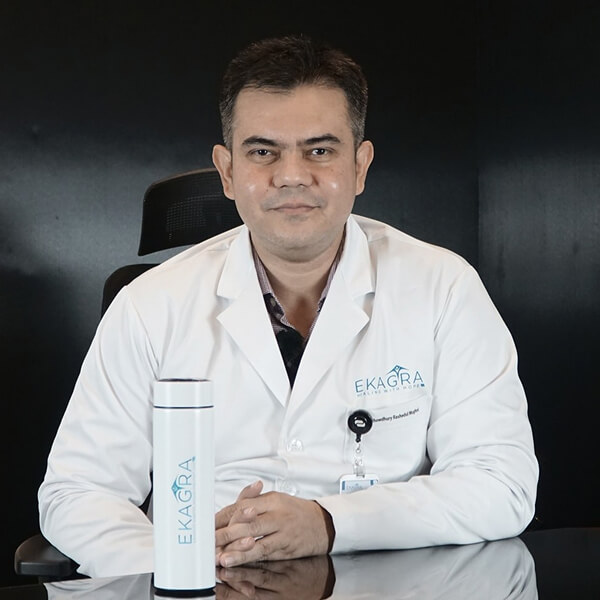
A mustache transplant moves individual hair follicles, usually from the back of the scalp, to the upper lip to add density, fill gaps or cover a scar. Dr. Chowdhury Rashedul Mughni performs the procedure in Dhanmondi, Dhaka. Transplanted hairs shed first, regrow from about three to four months, and the full result takes around ten to fourteen months.
Reviewed by Dr. Chowdhury Rashedul Mughni, BMDC reg. A 41174. This page is for general educational purposes and is not a substitute for in-person clinical assessment by a qualified plastic surgeon. Treatment decisions depend on individual factors that can only be evaluated during a consultation with Dr. Mughni.
What is a mustache transplant?
A mustache (moustache) transplant is a surgical procedure that places a patient’s own hair follicles into the upper lip, one follicular unit at a time. It is part of facial hair restoration, alongside beard, goatee and sideburn work.
The grafts are living hair, so once settled they can be trimmed and shaped like the rest of the face. The procedure is done under local anaesthetic, and most patients stay awake throughout.
Who is a candidate?
A good candidate has a healthy upper lip and enough donor hair. Common reasons for seeking one include:
• Sparse or patchy growth that has never filled in after puberty.
• Gaps on one side, so the mustache looks uneven.
• A scar on the upper lip from a burn, an injury, acne or an earlier cleft lip repair.
Facial hair is closely tied to identity and to how many men see their own masculinity.
Before surgery, any infection, inflammation or active acne on the lip is treated first, and topical minoxidil on the area is stopped before surgery.
How is the procedure done?
Dr. Mughni designs the shape with you, harvests grafts, then places each one at the angle of natural mustache hair, almost flat to the skin.
Dr. Mughni’s design rule is simple: “Following natural hairline and density keeps the result natural.”
FUE takes single follicular units with a fine punch, so there is no linear scar. FUT, the strip method, is the alternative and leaves a linear scar on the scalp.
| Donor option | Hair character | Main limitation |
|---|---|---|
| Back of the scalp | Reliable supply of thicker hair, usually the first choice | The supply is finite and may be needed for future scalp work |
| Beard under the jawline | Texture often closer to mustache hair | Limited yield; a test extraction may be advised first |
There is no fixed graft number for a mustache; it depends on the design, the area and the donor supply. Some patients choose a second session later for extra density, usually after about a year.
Can it be combined with a beard transplant?
Yes, a mustache and beard transplant can be planned as one design and done together. If your goals go beyond the upper lip, the full beard and goatee restoration guide covers the larger design.
How long until a transplanted mustache grows?
New growth starts at about three to four months, and the full result takes around ten to fourteen months. The lip can look fuller in the first days than a few weeks later: the short transplanted hairs are still in place, then they shed.
Dr. Mughni puts it plainly: “There will be hair fall which is absolutely normal after hair transplantation.”
| Stage | What to expect |
|---|---|
| First few days | Avoid pressing or rubbing the grafts |
| First 2 months | Transplanted hairs shed; nearby existing hair may also thin for a while |
| Months 3 to 4 | New growth begins |
| Months 10 to 14 | Full density and final result |
Strong sun should be avoided while the skin heals, which matters in Dhaka heat. The day-by-day recovery guide covers general aftercare. Inflamed follicles or small bumps under the lip are uncommon, and any that appear are checked at follow-up.
How is a mustache transplant planned for darker skin?
Darker skin does not rule out a mustache transplant; it needs planning around pigment changes. Many Bengali patients have medium to dark skin, which can develop dark marks at implant sites (sometimes needing treatment) or tiny pale dots where grafts were taken. A fine punch and measured harvesting limit donor dots; sun protection helps the implant area settle.
How much does a mustache transplant cost in Bangladesh?
Dr. Mughni prices hair transplant per graft, at BDT 25 to BDT 65 per graft depending on the technique. Fees may vary slightly between his two chambers. The final figure depends on the graft count, which is only decided after an in-person assessment. A fuller breakdown of hair transplant pricing in Dhaka explains what drives the per-graft rate.
The quoted range covers the surgeon fee, operation theatre charge and anaesthesia. Pre-operative investigations and medications are billed separately. The consultation fee is BDT 1,200 at EKAGRA Health, Dhanmondi, and BDT 1,500 at Cosmetic Surgery Centre, Satmasjid Road.
Frequently asked questions
Can a mustache really be transplanted?
Yes. Hair follicles moved from the scalp or beard continue to grow once they settle in the upper lip. The skill lies in matching the angle and direction of natural mustache hair, so the new growth blends in and can be groomed like any other facial hair.
Are the results permanent?
Grafts that survive healing are expected to keep growing long term. Early shedding is normal and is not a sign of failure. The shape you choose is lasting, so it is worth planning carefully, since shaving later can change how it looks.
Is a mustache transplant painful?
The procedure is done under local anaesthetic, so the main discomfort is the numbing injections at the start. Sedation is available but rarely needed. Afterwards, the grafts should not be pressed or rubbed for the first few days, and aftercare instructions are given before you go home.
How many grafts does a mustache need?
There is no standard number. The count depends on the mustache shape you want, the size of the area, the density planned, your hair thickness and the hair already there. The donor supply also sets a limit. Dr. Mughni works out a graft estimate at consultation, after examining both the lip and the donor area.
A natural result takes time
A mustache that suits your face is planned around your own hair direction, density and expectations, and it asks for patience through the shedding months. You can read about Dr. Mughni’s surgical training and credentials, or explore his wider guide to hair restoration. To discuss whether the procedure suits you, you can arrange a consultation with Dr. Mughni at EKAGRA Health.