


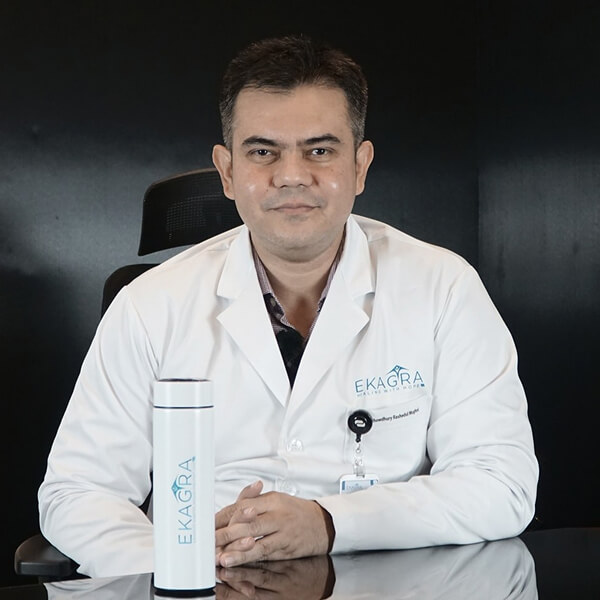
Rhinoplasty is surgery to reshape the nose for appearance, breathing, or both. This guide covers who is a candidate, how the operation is performed, what recovery actually looks like for Bengali patients, the risks, and what determines cost in Bangladesh. Dr. Chowdhury Rashedul Mughni performs rhinoplasty at EKAGRA Health, Dhanmondi.
Reviewed by Dr. Chowdhury Rashedul Mughni, BMDC reg. A 41174. “I prefer preserving cultural features and natural body-structure.” This page is for general educational purposes and is not a substitute for in-person clinical assessment by a qualified plastic surgeon. Treatment decisions depend on individual factors that can only be evaluated during a consultation with Dr. Mughni.
To find out whether rhinoplasty is right for you, you can schedule a consultation with Dr. Mughni at EKAGRA Health, Dhanmondi. Consultations are available by arranging an appointment or on WhatsApp at 01842-182545.
What is rhinoplasty?
Rhinoplasty is surgery that reshapes the bone, cartilage and soft tissue of the nose to change its appearance, improve breathing, or both. It is performed by a plastic surgeon or a facial plastic surgeon, and in Dhaka it is usually carried out under general anaesthesia.
Patients come to it for very different reasons: a dorsal hump, a deviated nose, a broad or undefined tip, or no aesthetic concern at all and simply an inability to breathe through one side. A large share of cases combine aesthetic and functional concerns, which is why the operation is planned around the whole nose rather than a single feature.
Injury is a common route to nasal surgery here. In a published series of 50 rhinoplasty and septorhinoplasty cases at Combined Military Hospital, Dhaka, the single most common cause of nasal disfigurement was traumatic injury sustained during games, accounting for 40 percent of cases. Post-traumatic noses are routine here, not an exception, and they overlap heavily with the wider field of reconstructive work Dr. Mughni performs.
Surgery is not always the answer. Filler-based nasal reshaping is a separate, temporary option with its own limits, discussed at consultation rather than offered as an equivalent.
Who is a candidate for rhinoplasty?
A candidate is a physically healthy patient whose facial growth is complete, who has a specific and describable concern, and who understands what surgery can and cannot change.
Facial growth matters. Operating on a nose that is still developing risks affecting its final shape, so surgeons wait until growth is complete. A systematic review of adolescent growth data placed nasal maturity at around 15.8 years in girls and 16.9 years in boys, and concluded that rhinoseptoplasty can be performed safely from about 16 in girls and 17 in boys. Those figures come from studies of white adolescents, so maturity is assessed in the individual patient rather than read off a birthday. When a young patient is old enough for nasal surgery is a question worth settling before anything else is planned.
Functional candidacy is assessed separately from aesthetic candidacy. A deviated septum, collapse of the internal or external nasal valve, or obstruction following injury are all surgical problems in their own right. If breathing is the primary complaint, the operation may be a septoplasty or a septorhinoplasty rather than a cosmetic rhinoplasty, and the distinction between correcting airflow and changing shape changes the plan, the recovery and the cost.
| Functional nasal surgery | Cosmetic rhinoplasty | |
|---|---|---|
| Reason for surgery | Obstructed breathing | Appearance of the nose |
| Usual operation | Septoplasty or septorhinoplasty | Rhinoplasty |
| What changes | Airflow, and shape where the deviation is external | Shape, projection, proportion |
| Assessed by | Examination of the septum, valves and airway | Examination plus discussion of goals |
Many patients need both, and the two are planned together in a single operation.
Because rhinoplasty is elective there are no absolute contraindications, but there are firm relative ones. Uncontrolled bleeding disorders, unstable heart or lung disease, active infection in the nose and current smoking are addressed before an operation is scheduled. Expectations are assessed as carefully as anatomy. A patient seeking surgery to resolve something that is not about the nose is not helped by an operation.
How is rhinoplasty performed?
Rhinoplasty is performed through incisions inside the nostrils, with or without a small external incision, and is often carried out as a day case. General anaesthesia is the usual choice, though local anaesthesia with sedation is used in selected cases, decided with the anaesthetist on the basis of the planned work and the patient’s health. The operation takes longer where the work is more extensive.
There are two approaches. In the closed, or endonasal, approach all incisions sit inside the nostrils and nothing is visible externally. In the open approach a small incision is added across the columella, the strip of skin between the nostrils, which lifts the skin envelope and gives direct sight of the framework underneath. Open access makes precise grafting and tip work possible and is the usual choice for complex deformity, significant deviation, and revision cases. Closed suits smaller, well-defined changes. Neither is inherently superior, and the choice between the two approaches follows the anatomy rather than a preference.
Underneath, the work falls into a few categories. The septum is straightened where it is deviated. The bony pyramid is narrowed or lowered with controlled osteotomies. Cartilage at the tip is reshaped, repositioned or supported with grafts, harvested from the septum first, then the ear, and from the rib in larger reconstructions.
The direction of modern practice is worth understanding as a patient. Rhinoplasty has moved steadily away from cutting structure out and towards preserving and repositioning it, on the reasoning that a preserved dorsum looks more natural than a rebuilt one. The technical principle and the surgical philosophy point the same way: what is preserved tends to look more natural than what is rebuilt.
Grafting decisions in particular are governed by skin thickness. A thick soft-tissue envelope does not drape tightly over small changes, so suture techniques that produce visible definition in thin skin often produce none at all in thick skin. In those patients, structural support at the tip does the work instead. This is one of the specific ways that nasal surgery in South Asian patients differs in execution, not just in aesthetic goal.
Dr. Mughni explains how a nose is assessed before surgery and what the open and closed approaches involve.
[VIDEO EMBED] Dr. Mughni explains how a nose is assessed before surgery and what the open and closed approaches involve.
What does recovery look like?
Most patients are presentable within two weeks and back to normal activity within six, but the nose keeps refining for a full year, and longer where the skin is thick.
The external splint stays on for about a week and is removed at the first review. Stitches, where they are not dissolvable, come out in the same visit. That first week is mostly blockage rather than pain. Patients sleep propped up, breathe through the mouth, and find the splint an odd weight on the face rather than a sore one. The nose looks swollen and undefined the moment the splint comes off, and that is the expected sight, not a bad sign.
Bruising and swelling around the eyes are expected, and usually take two to three weeks to disappear fully. NHS guidance suggests planning for up to two weeks away from work, with bruising, swelling and redness settled by around three weeks and strenuous exercise resumed at four to six weeks. Contact sports wait roughly three months, because the healing framework will not tolerate a knock.
What patients are least prepared for comes last. Swelling does not resolve on a neat schedule. It leaves the bridge quickly and the tip slowly, so there is a stretch of months where the profile already looks correct and the tip still looks undefined. Published ultrasound measurement shows why. In patients with a thin soft-tissue envelope, tissue thickness at the bridge peaks around the third month and then falls. In patients with a thick envelope, there was no measurable difference between the third month and the tenth, meaning the swelling simply had not gone yet at ten months.
This is expected healing, not a complication, and it is the most useful thing a patient with thicker nasal skin can be told beforehand. The thick-skin literature describes the same pattern: a less elastic envelope, prolonged swelling, and a result that declares itself late. Planning for twelve months, and accepting that a thick tip may take longer, prevents a great deal of unnecessary worry at month four. A stage-by-stage account of the healing period sets out what to expect at each point.
What are the risks of rhinoplasty?
The main risks are bleeding, infection, persistent swelling, asymmetry, contour irregularity and a change in breathing, and results cannot be guaranteed.
Bleeding, infection and reaction to anaesthesia are the general surgical risks. The nose-specific ones matter more to the decision: swelling that persists, asymmetry, contour irregularity that becomes visible as the skin settles, altered sensation at the tip, and a result that does not match what the patient had pictured. Where an open approach is used there is a small external scar at the columella, usually inconspicuous once healed.
Management begins before the operation. Medical conditions are stabilised, blood-thinning medication is reviewed, smoking is stopped, and photographs are taken from standard angles so that the plan is documented rather than remembered. In surgery, preserving structure wherever it can be preserved and supporting the tip adequately both reduce the chance of late contour problems. Afterwards, splinting, head elevation and reviews at set intervals catch problems while they are still small.
Some patients need a second operation, either for a residual breathing problem or for a contour they remain unhappy with. Revision is technically harder than primary surgery, because scar tissue alters both blood supply and healing, and swelling afterwards resolves more slowly. The full picture of what can go wrong and what a second operation involves are covered separately.
How much does rhinoplasty cost in Bangladesh?
Cost depends on what is actually being done, and no honest figure can be quoted before an examination.
One confusion is worth clearing up because it causes real distress at consultation. Correcting a deviated nasal bone or septum for breathing, and reshaping the nose for appearance, are quoted very differently in Dhaka, and patients frequently arrive having seen a figure for the first and expecting it to apply to the second.
The factors that move the cost are the extent of the work, whether cartilage has to be harvested and from where, the anaesthesia and theatre time required, whether the case is primary or revision, and the pre-operative investigations needed. A revision costs more than a primary operation for the same reason it takes longer.
A figure quoted before an examination is an estimate at best. What a consultation produces is an assessment and a plan, and the cost follows from the plan. What determines the price of nasal surgery here is set out in more detail on its own page.
Dr. Mughni’s approach to rhinoplasty
Dr. Chowdhury Rashedul Mughni notes:
“I prefer preserving cultural features and natural body-structure, for rhinoplasty and also for other body reshaping surgeries. Always a pre-operative discussion with the patient is a must to task for me.”
This is a surgical position, not a sentiment. Much of the rhinoplasty writing available online is built around East Asian anatomy, where a low bridge and a weak cartilage framework make augmentation the default operation. That template does not transfer cleanly to Bengali patients.
Anthropometric studies of adult Bengali men in Bangladesh report a mean nasal index in the leptorrhine, or narrow-nosed, range, with around seven in ten falling into that category. In practice that means reduction, straightening and tip refinement are common here, and importing an augmentation-first approach would be wrong for a large share of patients.
In clinic the discussion usually begins with a photograph. Patients arrive with an image of an actor or a face from social media and ask for that nose. The first job is to map what their own bone, cartilage and skin can support, and to say plainly which parts of the request the anatomy will carry. Thick skin, in particular, sets a limit on how much tip definition is achievable no matter how the cartilage is shaped. A patient who leaves that conversation knowing where the limit sits is far better placed than one who leaves with an expectation the nose cannot meet.
The second half of the quote carries as much weight as the first. The Dhaka series cited earlier reached the same conclusion from the outcome side: the authors concluded that adequate pre-operative counselling and realistic expectations are what produce satisfied patients. A pre-operative discussion covers what the anatomy will allow, what the skin will show, how long the result will take to appear, and what will not change. A patient who has had that conversation reads month four correctly. A patient who has not reads it as failure.
Preserving cultural features does not mean declining to change anything. It means the goal is a nose that belongs to the face it sits on, not a shape borrowed from somewhere else.
Photographs of previous results show what that looks like in practice. Every image is published only with the patient’s consent, and faces are blurred. Photographs are also the most useful thing to look at before a consultation, because they set a realistic reference point.
Why patients choose Dr. Mughni for rhinoplasty
Patients want to know who is operating, and whether the operation is being recommended for the right reasons.
Dr. Mughni is a plastic, aesthetic, reconstructive, diabetic foot and hair transplant surgeon with over two decades of surgical experience and more than twelve years specialising in plastic surgery. He holds FCPS, MRCS and MRCSEd, is registered with the Bangladesh Medical and Dental Council under number A 41174, and is a member of ISAPS. His full training history and career timeline are set out on his professional profile.
His reconstructive background is directly relevant to nasal surgery rather than incidental to it. Post-traumatic noses, structural rebuilding, and cases where function has to be restored alongside appearance all draw on it. Where a concern does not call for surgery at all, the non-surgical side of the practice covers the alternatives. Restoring form and function without overstating what surgery can deliver is the standard here.
Where does Dr. Mughni perform rhinoplasty?
Consultations and surgery are available at both of Dr. Mughni’s chambers in Dhanmondi.
EKAGRA Health is the primary chamber, at Wahab Point, Floor 7, House 13, Road 2, Dhanmondi, Dhaka 1209. Consultation hours are Saturday, Monday and Thursday from 4:00 PM to 8:00 PM, and Sunday, Tuesday and Wednesday from 9:00 AM to 2:00 PM.
The second chamber is Cosmetic Surgery Centre Ltd., on the 5th floor of Shankar Plaza, 72 Satmasjid Road, Dhanmondi R/A, Dhaka 1209. All procedures, consultations and surgeries are available at both locations. Consultation times there are confirmed when the appointment is booked.
Patients travelling from outside Dhaka or from abroad can consolidate the consultation and pre-operative assessment into a single visit, arranged in advance. An overview of the practice and the areas it serves covers the practical details.
To discuss whether nasal surgery suits your anatomy and your goals, you can request a consultation or reach the chamber on WhatsApp at 01842-182545.
Frequently asked questions
Is rhinoplasty painful?
The operation itself is performed under general anaesthesia, so nothing is felt during surgery. Most patients describe the days afterwards as pressure and blockage rather than sharp pain, similar to a heavy cold. Discomfort is managed with prescribed medication and settles within the first week.
How long before I can return to work?
Plan for up to two weeks. The splint comes off at about one week, and most bruising has faded by two to three weeks. Desk-based work is usually manageable once the splint is removed, though visible bruising varies between patients and jobs differ in what they demand.
Will the surgery leave a visible scar?
In closed rhinoplasty all incisions sit inside the nostrils and nothing is externally visible. In open rhinoplasty there is a small incision across the columella between the nostrils. It is usually inconspicuous once healed, but it is a scar, and no surgery is possible without one.
Can rhinoplasty fix breathing problems?
Yes, where the obstruction is structural. A deviated septum, collapsed nasal valve, or damage following injury can be corrected surgically, often at the same time as reshaping. Breathing complaints caused by allergy or infection are treated medically instead, so the cause is established before surgery is considered.
When will I see the final result?
Allow twelve months. Most swelling resolves within the first few months and the bridge settles early, but the tip is last. Where the nasal skin is thick, measurable swelling can persist beyond ten months. This is normal healing rather than a sign that something has gone wrong.
What is the right age for nasal surgery?
Facial growth must be complete. Published growth data places nasal maturity at roughly 16 in girls and 17 in boys, though this is assessed in the individual patient rather than by birthday alone. Operating earlier risks affecting how the nose develops. There is no upper age limit provided general health supports surgery and healing.
Further questions are answered on the rhinoplasty questions page.
Rhinoplasty is a demanding operation on a structure at the centre of the face, and it rewards patience more than enthusiasm. The right result comes from an accurate assessment, a realistic plan, and a patient who knows what the next twelve months will look like. To find out what is possible for your nose, arrange a consultation with Dr. Mughni at EKAGRA Health, Dhanmondi.